


Cooking with Annatto Seeds: The Natural Colouring Spice You Need to Try
If you have ever wondered what gives certain Latin American dishes their beautiful golden-orange colour, or why some cheeses are that particular shade of orange — the answer is almost certainly annatto. Derived from the seeds of the Bixa orellana tree, annatto (also called achiote) is the most widely used natural food colouring in the world, and it has been central to Latin American, Filipino, and Caribbean cooking for centuries. But annatto is not just for colouring — it also imparts a mild, earthy, slightly peppery flavour that adds genuine character to anything it touches. This is a guide to getting started with annatto seeds in your kitchen.
What Do Annatto Seeds Taste Like?
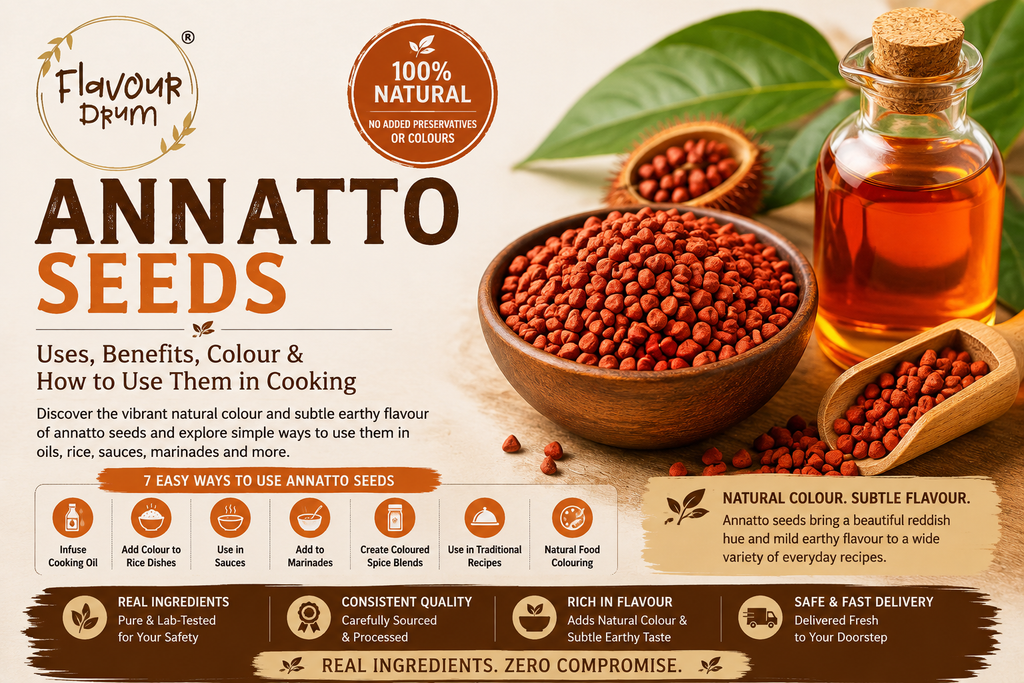
Annatto seeds have a mild, earthy flavour with subtle notes of pepper and a very faint bitterness. On their own, the seeds are not particularly pungent or overwhelming — the flavour is gentle and builds depth in dishes rather than asserting itself loudly. This makes annatto very versatile: it adds colour and a quiet complexity without competing with other flavours in a dish.
The colour of annatto is its most striking quality — even a small amount infused into oil turns it a vivid golden-orange that transforms the visual appearance of any dish. Think of the burnished gold of traditional Filipino pancit, the orange richness of cochinita pibil, or the warm amber of Latin-style rice.
The Foundation Technique: Making Annatto Oil
Annatto oil (also called achiote oil or aceite de achiote) is the most fundamental preparation and the starting point for countless recipes. It is extraordinarily easy to make and keeps for several weeks in the refrigerator.
Heat half a cup of neutral oil (vegetable, sunflower, or coconut) in a small saucepan over medium-low heat. Add two tablespoons of annatto seeds. Watch as the oil gradually turns from clear to golden to a vivid burnt-orange colour — this takes four to six minutes. Do not let the oil get too hot or the seeds will scorch and turn the oil bitter. Once the oil is a deep orange, remove from heat, let it cool slightly, then strain out the seeds. The resulting oil can be stored in a sealed jar in the refrigerator for up to three weeks.
Use this oil anywhere you want colour and subtle annatto flavour: as the base for sautéing onions and garlic, drizzled over dishes as a finishing oil, or brushed over meat before grilling.
Latin American Classics: Achiote Paste and Cochinita Pibil
In Mexican and Central American cooking, annatto seeds are most famously used in achiote paste — a thick, brick-red condiment made by blending annatto seeds with cumin, oregano, cinnamon, cloves, black pepper, garlic, and sour orange juice (or a combination of orange and lime juice). Achiote paste is the defining ingredient of cochinita pibil, the Yucatecan slow-roasted pork dish that is one of Mexico's great culinary treasures.
To make a simplified achiote marinade at home: grind two tablespoons of annatto seeds with one teaspoon of cumin, half a teaspoon of oregano, a pinch of cinnamon, four garlic cloves, the juice of one orange and one lime, and salt to taste. Use this paste to marinate chicken, pork, or fish for at least two hours before grilling or baking. The result is beautifully coloured, deeply flavoured meat with that distinctive Yucatecan earthiness.
Filipino Cooking: Annatto in Pancit and Kare-Kare
In Filipino cuisine, annatto (called achuete) is used to colour and flavour several iconic dishes. Pancit palabok — a beloved rice noodle dish with a shrimp-based sauce — gets its characteristic orange colour from annatto oil. Kare-kare, a rich peanut-based oxtail stew, also uses annatto for its golden colour.
For a simple Filipino-inspired annatto rice: cook your usual rice but replace a quarter of the water with annatto-infused water (soak annatto seeds in hot water for fifteen minutes, then strain). The rice turns a beautiful golden colour and has a subtle earthiness that works wonderfully with grilled meats and seafood.
Natural Food Colouring for Home Cooking
One of the most practical uses for annatto seeds in any kitchen — regardless of cuisine — is as a natural food colouring. If you want to give rice, pasta, bread, or pastry a warm golden-orange colour without artificial dyes, annatto is your answer.
For naturally coloured golden pasta dough: make annatto oil (as above), allow it to cool, and use it as the oil component in your pasta dough recipe. The pasta will be a beautiful deep yellow-orange that looks stunning on the plate. For bread, dissolve a teaspoon of annatto powder (ground seeds) in warm water before adding to the dough.
Indian and South Asian Applications
While annatto is less traditional in Indian cooking than in Latin American or Filipino cuisine, it has practical applications as a natural replacement for artificial food colours in Indian recipes. Some cooks use it as a natural alternative to artificial orange food colouring in biryani, tandoori marinades, and mithai (Indian sweets).
A small amount of annatto-infused oil used as the cooking base for a biryani adds a beautiful colour to the rice without the synthetic taste or health concerns of artificial dyes. In tandoori marinades, adding a pinch of ground annatto powder to the spice blend produces the characteristic red-orange colour that is traditionally achieved with artificial food colour.
How to Store Annatto Seeds
Annatto seeds are quite hardy and keep well when stored correctly. Keep them in an airtight container in a cool, dark place away from direct sunlight and heat. Properly stored whole annatto seeds will maintain good quality for up to two years. Ground annatto powder has a shorter shelf life — about one year — as the increased surface area accelerates oxidation and flavour loss.
FlavourDrum's annatto seeds are packaged in resealable, moisture-resistant bags to maintain freshness. The deep reddish-orange colour of fresh annatto seeds is a good indicator of quality — seeds that have faded to a pale brown or tan are past their prime.
Related post
02
Sep
02
Sep
02
Sep


